


When you’re a one-person business, every hour in the week counts – and so does every marketing dollar. That’s something Scott, owner of The Massage Guy, knows better than most.
For years, Scott ran a successful but modest solo massage practice in Minneapolis, specializing in deep tissue, pre- and postnatal, sports recovery, and wellness massages.
When Scott first reached out to Haven Media Solutions a year ago, he was in a spot familiar to a lot of solo service providers: a flatlined revenue at around $7,000/month and a feeling of being near-invisible online. Word-of-mouth was never going to fill his calendar, and he wanted real, sustainable growth, not just a random surge in bookings one month and crickets the next.
Fast-forward a year to now, and The Massage Guy is pushing $17,000 months – an increase of almost 2.5x. Even more importantly, the waitlist is growing and Scott is preparing to expand his business by bringing on new therapists.
This case study is a look at exactly what drove that growth: the strategies, tactics, and tools that turned a one-man show into a thriving, in-demand brand.
Table of Contents
- The Problem: Why Most Service Businesses Hit a Plateau
- Website Optimizations: A Funnel That Works
- Automation That Feels Human, and Saves You Time
- Google Ads or Facebook Ads?
- Creating Messaging That Resonates: Inclusivity and Authenticity as Business Drivers
- Moving Beyond Discounts: How Scott Increased Revenue by an Additional 25%
- The Power of Real Connection: Newsletters and Two-Way Texting
- Reaching Capacity and Scaling Up
- Takeaways for Local Service Businesses: It’s About People, Not Just Platforms
Diagnosing the Problem: Why Most Service Businesses Hit a Plateau
Scott’s story isn’t unique; most local service providers get stuck here. They hit a ceiling of what friends, referrals, and existing clients can deliver, but their online presence isn’t working hard enough for them. For Scott, this meant plenty of five-star reviews on Google and a loyal client base, but a calendar that still had more empty spots than he wanted, especially during slower weeks or outside peak hours.
Plenty of talented solo practitioners deliver amazing results but can’t seem to break through to the next level. The common thread? Their online presence doesn’t work for them. As a solo practitioner, it’s important that things be optimized and streamlined so that you’re not chasing after the next lead when you could be providing service to more and more people.
When Scott reached out to us, his website was basically an online business card. It didn’t speak to the real needs or concerns of his ideal clients. The booking process was clunky. And his attempts at paid advertising (mostly Google placement ads) were simply not pulling in consistent results.
He knew he needed a real marketing strategy and lead-nurturing system that actually brought in the kind of clients who would become regulars. That’s exactly what we set out to build for him.
Rebuilding a Basic Website into a Client-Generating Funnel
The first thing we did was rebuild Scott’s website from the ground up – not just visually, but strategically.
We started with a full redesign of the homepage, with the intention of using it as the landing page for our PPC campaigns. We put booking front and center and made the site a friendly, welcoming invitation to connect. Instead of stock photos and generic copy, we leaned into Scott’s personality – using real headshots and photos of Scott working with clients. Right away, visitors could put a face to the name, making the experience more personal and trustworthy.
The site copy was rewritten to speak directly to his ideal clientele: athletes rehabbing injuries, new moms looking for relief, busy professionals with chronic tension. We made it incredibly easy to book a session by putting the booking form directly on the landing page (no “Click here to book!” buttons that lead to a different page, which would introduce another barrier of entry).
By adding messaging that inspired trust and confidence, as well as simplifying the booking process, we saw people actually sticking around on the website rather than clicking away as soon as it loaded.
Automation That Feels Human, Plus Saves Time
A lot of small businesses fear automation because they worry it’ll make them feel less personal. For Scott, we built a booking and follow-up system that did the opposite. The multi-step form on his website gets the client’s name, contact info, and accepts payment when they book a massage, but the real time saver is what happens after they leave the page.
For the booking form on the landing page, we built it to be a multi-step form that pushed every new contact directly into a customized follow-up sequence as soon as they entered their contact information. This means that even if someone abandons the form and decides not to book halfway, we still had their information saved to Scott’s CRM (which we set up and customized for him). The CRM then triggers a sequence of text and email booking reminders, and the messaging sounds like Scott: helpful, and non-pushy.
No more missed opportunities from people who “almost booked.” Every visitor who expressed interest received friendly, personalized reminders via email and text, all branded with Scott’s voice. People who didn’t book at first touch-point ended up booking just days later.
Testing, Iterating, and Zeroing In: How We Found Scott’s Ideal Marketing Channel in Facebook Ads
With the website working as a proper funnel, the next step was fueling it with new, targeted traffic. We tested both Google Ads and Facebook Ads in those early months, targeting people searching for massage near Minneapolis and those with interests or recent behaviors indicating they might be in the market for bodywork.
Google Ads, while it can be useful for capturing some high-intent searches, turned out to be expensive for the kinds of terms Scott’s ideal clients were using. There was too much competition, and not enough quality leads to justify the ad spend. On the other hand, Facebook offered something different: the ability to put Scott’s story and face directly in front of people who might never have thought to Google for a massage, but were just one reminder away from realizing they needed it.
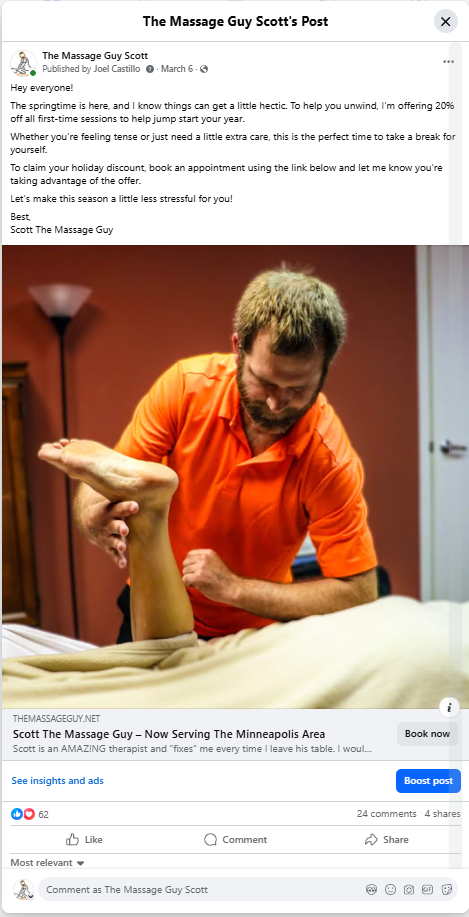
What was great about Facebook ads for Scott was that since he had already established himself as someone who provides great service, the ads were getting great traction from even his past clients. We were seeing past clients of Scott’s commenting on our ads, singing their praises about Scott and his massages. Past clients being reactivated and booking again with Scott for the first time in months or years. Past clients even answering the questions of people looking to book, but still curious about some things before they committed.
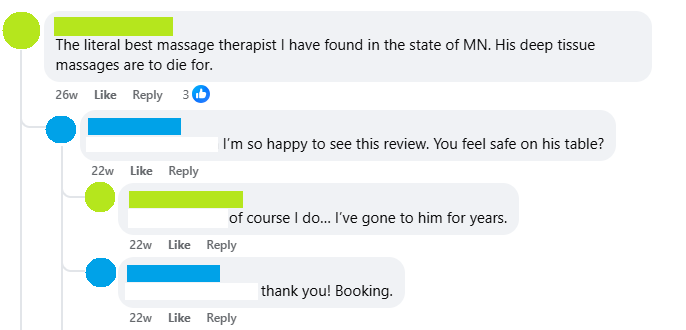
Facebook gave us room to tell Scott’s story. We could use inviting photos that show that Scott knows what he’s doing, friendly language, and even the community discussions happening in the comments sections to help prospects feel like they “knew” Scott before ever stepping in the door. For Scott’s audience, human connection mattered – a lot. That’s the real lesson here: it’s not about Facebook being the magic bullet for every business, it’s about finding your audience where they want to interact and delivering your message in a way that builds trust.
Creating Messaging That Resonates: Inclusivity and Authenticity as Business Drivers
One of the things that really set Scott apart in the Minneapolis massage market was his openness and inclusivity. Instead of corporate-sounding, one-size-fits-all ads, we leaned into what makes Scott unique. For example, during Pride Month, we ran an ad campaign that highlighted Scott’s welcoming approach, making it clear that people of all backgrounds and identities were welcome at The Massage Guy.
This wasn’t a token gesture. The ad featured a warm, straightforward message about acceptance and comfort for everyone. You can take a look here:
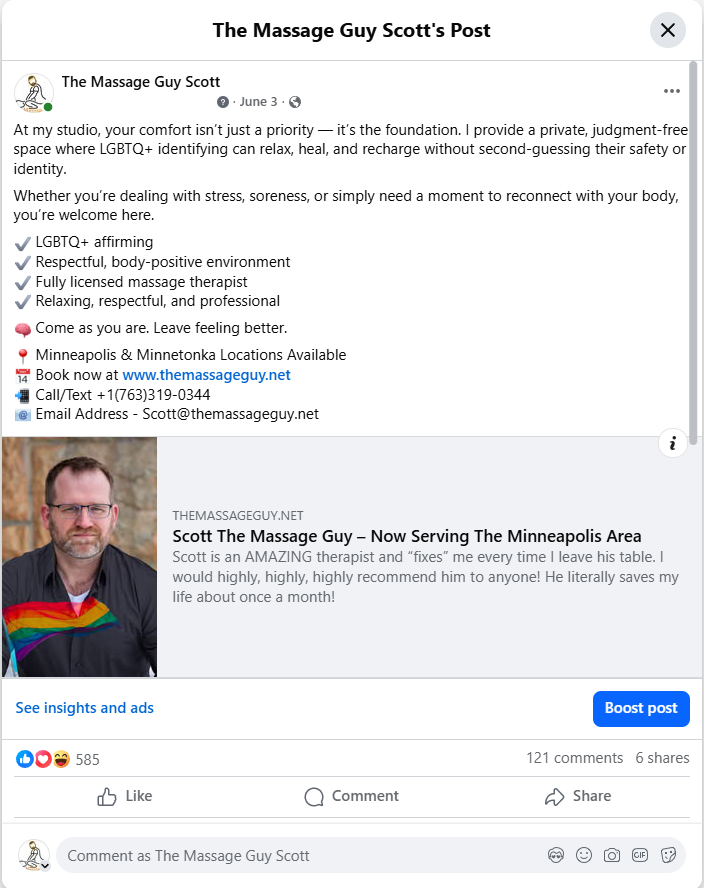
As you can see above, the response was overwhelming: not only did the ad generate hundreds of new leads and bookings, it also sparked real conversations in the comments and was shared organically within the local LGBTQ+ community.
The impact went even deeper. Scott’s site began ranking on Google for searches related to LGBT-friendly massage in the area, simply because of the response and relevance of the Facebook ad, even before we did any SEO work around those terms. The ad had become a magnet, drawing in a new segment of clients who had previously felt overlooked by more generic or “corporate” massage businesses.
This wasn’t a one-off. Months later – well into October – the same ad continued to drive new inquiries, bookings, and organic search visibility. It proved a core truth: authenticity and belonging aren’t just buzzwords, they’re business drivers. When you show up as yourself, your ideal clients recognize it, and respond. Authentic, inclusive messaging doesn’t just “feel good”; it opens doors to whole new audiences that generic marketing misses.
Moving Beyond Discounts: How Scott Increased Revenue by an Additional 25%
Early on, Scott wanted to try what he had been doing until now – running Google placement ads with a 20% discount offer. We used that same 20% off offer for his first Facebook campaigns, knowing that an introductory offer can be a powerful motivator when you’re just starting to ramp up paid acquisition. With that being said, we believe in avoiding devaluing one’s services, so we had our eye on phasing that discount out as soon as it was attainable.
Leaning on the 20% discount to drive quick action worked – leads started rolling in and Scott’s calendar began to fill. But unlike with his earlier attempts, this time the flow didn’t dry up. As we refined targeting, optimized ad creative, and dialed in the messaging, the lead quality kept improving.
Within several months, we were able to do something that most service businesses only dream about: we stopped offering the discount altogether. The demand from Facebook ads was so strong, and Scott’s brand so well established with his ideal clients, that he could fill his schedule at full price. For Scott, that meant a direct pay raise, essentially pocketing 25% more from every new client without having to do anything differently. In a business where your time is your product, that’s the kind of win that changes everything.
The Power of Real Connection: Newsletters and Two-Way Texting
Beyond the website and ads, we set up two powerful retention tools to keep Scott’s client base engaged and drive repeat bookings: a weekly newsletter and two-way SMS blasts.
Every Monday, Scott’s clients receive a short, personable email covering a topic relevant to their wellness – sometimes about stretching, sometimes about stress relief, always with Scott’s genuine voice and a heads-up about his open spots for the week. Because the newsletter goes out to everyone who has ever expressed interest, it’s both a valuable resource and a gentle nudge to book again.
The trick was to keep the voice casual and authentic, exactly as if Scott was texting a friend. Immediately, clients started to reply to the emails, treat them as conversations, and forward them to friends and family. It wasn’t just a marketing list; it was a genuine way to speak to the clients and have dialogues.
Text marketing played a big role, as well. Unlike mass emails, SMS has a sense of immediacy, and the platform we used allowed for true two-way conversations. When Scott ran a last-minute special or opened up a new slot, he could blast a message to a segment of his clients, and they could book instantly by replying. Clients loved the direct connection, and the response rates blew past industry norms.
Reaching Capacity and Scaling Up
Now in autumn of 2025, The Massage Guy is consistently booked out, with some clients waiting weeks for an opening. Revenue has surged to $17,000/month. But growth brings its own challenges. Scott is working more hours than ever, but there’s only so much one person can do. Now, Scott has started bringing other massage therapists into the practice to keep up with the demand
This pivot is its own chapter, but it’s worth highlighting: good marketing doesn’t just fill a calendar. It creates demand – and sometimes, it forces you to grow the business beyond yourself. Now, The Massage Guy is actively recruiting, expanding services by bringing in people experienced in different massage modalities, and planning for a bigger future.
Takeaways for Local Service Businesses: It’s About People, Not Just Platforms
Scott’s journey with Haven Media Solutions proves that growth isn’t about chasing the latest trend or dumping money into the biggest platform. It’s about finding your audience, speaking to their real needs, and showing up as a real person. For Scott, Facebook Ads worked not because Facebook is always the answer, but because it allowed him to tell his story, connect authentically, and build trust with the people who need his help.
If you’re a solo practitioner or small business owner, the lesson is clear: build your marketing around what makes you unique, let your clients see the real you, and never stop experimenting until you find what works. And when you’re ready to go from stuck to scaling, find a partner who can help you make it happen.
The Breakdown:
- Don’t treat your website as a brochure. Show your personality, your values, how you help. Make it a funnel, and make it work for you.
- Test your marketing channels, but double down on what actually brings results. For Scott, that was Facebook over Google.
- Lead with authenticity. Messages that show who you are and who you welcome will outperform generic “deals” every time.
- Use booking forms and automation to capture interest and follow up, but keep your voice human.
- Leverage SMS and email as true communication channels. Make it easy for clients to talk to you directly while reminding them to book again, or for the first time.
- Be ready for the next phase of growth. If your marketing works, you’ll have to scale–so plan for it.
What’s Next for The Massage Guy – and Your Practice?
Scott’s story is still unfolding. With new therapists joining, a loyal and growing client base, and a reputation as one of Minneapolis’s most welcoming practices, the next year will bring its own set of challenges and opportunities. But the foundation is set: an authentic brand, a marketing system that actually works, and a business built to serve real people.
If you’re a solo practitioner or small business owner wondering how to make the leap from “busy but stuck” to “in demand and growing,” take a page from Scott’s playbook: lead with who you are, make every client feel seen, and let your marketing work as hard as you do.